Martina Bussettini, Francesca Piva
The Water Framework Directive (WFD) - Directive 2000/60/EC - requires that for each river basin district, within the River Basin Management Plan (RBMP), also known as the Water Management Plan (WMP), a "Program of Measures" (PoM) is established. This program, based on the analyses carried out, should enable the achievement of environmental objectives set by the directive (a "good" status for natural water bodies; a "good" potential for heavily modified or artificial water bodies) by 2015. Environmental quality objectives can be exempted or extended in specific cases explicitly provided for by the WFD.
The WFD distinguishes between "basic measures" and "supplementary measures." The former essentially consist of applying measures required by other specific directives (e.g. Nitrates Directive, Habitats Directive) and are listed in Part A of Annex VI of the WFD; the latter are additional measures (e.g. river restoration, knowledge enhancement, fiscal tools) and are included in Part B of Annex VI in a non-exhaustive list.
Given the variety and level of detail of the measures, for reporting purposes, the measures in the PoM are grouped into 25 macro-categories, the "Key-Type of Measures" (KTM). Each KTM serves to mitigate the impact of one or more pressures, and it is possible to link them to each other. In other words, for each KTM, the percentage of significant pressure types these measures aim to mitigate can be represented.
The processed information comes from the six-yearly reporting of Water Management Plans prepared by the district basin authorities as required by the Water Framework Directive -2000/60/EC. The data refer to the period 2010–2015.
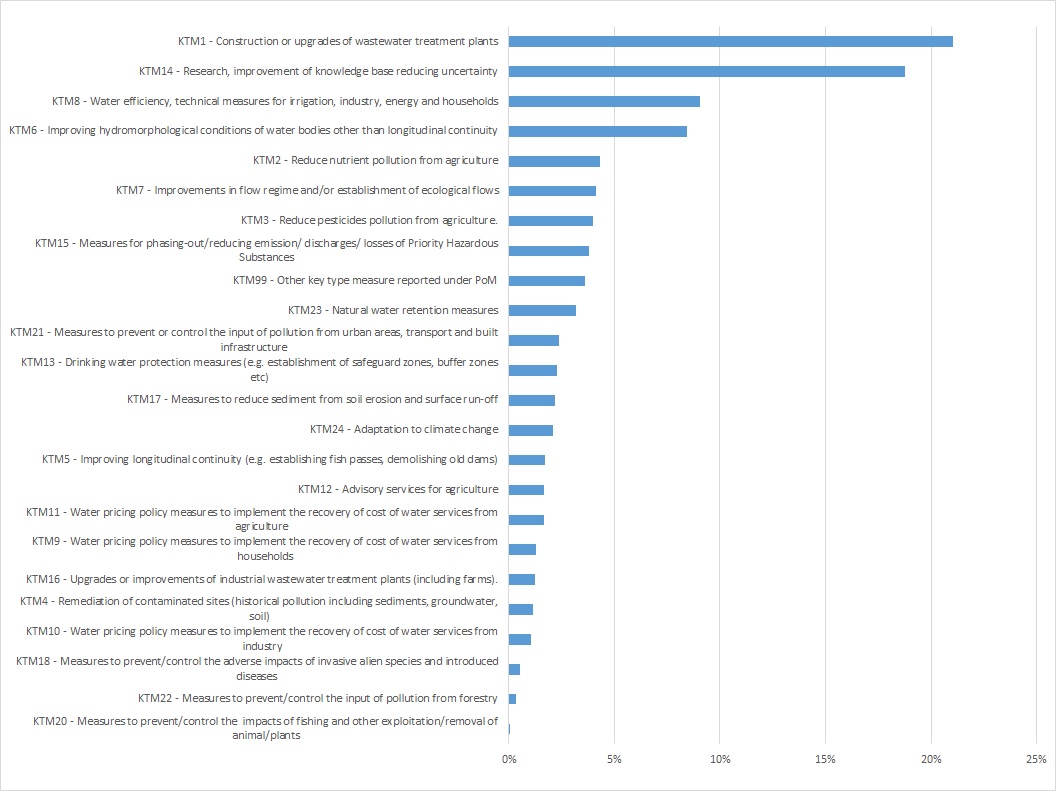
The indicator represents the frequency of use of measures by macro-categories (Key-Type of Measures - KTM) across the national territory.
The list of KTMs (Table 1) is defined in a European Commission guideline (WISE Reporting Guidance 2016), which contains the technical specifications for reporting information included in the Water Management Plans. Additionally, it provides an overview of the KTMs used in the Management Plans concerning the types of pressure they aim to mitigate, distinguished between surface waters and groundwater.
Pressures are considered "significant" if they threaten the achievement of environmental objectives. The pressures have been grouped by type: point pressures, diffuse pressures, withdrawals, hydromorphological pressures, unknown or others.
To describe the types of measures adopted in the district management plans to mitigate the impacts of significant pressures on water bodies.
- Water Framework Directive 2000/60/EC
- Legislative Decree 152/2006
The Water Framework Directive requires the preparation of a program of measures necessary to achieve the environmental objectives outlined in Article 4 of the directive.
- WFD Reporting Guidance 2016
- Water Framework Directive 2000/60/EC
- Legislative Decree 152/2006
- District Management Plans
Compiling the indicator for the KTMs used in the Management Plans concerning the types of pressures they aim to mitigate is highly demanding, as the measures included in the WMPs are numerous and fall under the responsibility of various territorial authorities. As a result, only some of the 8 District Authorities provided the information needed to construct the indicator.
Authorities of the District Basin
Water Management Plans contain the measurement programmes and the same information is reported, standardised at European level, through the WISE Reporting. This information can be found in the Management Plans accessible on the sites of the District Basin Authorities and, as WISE reporting, on the SINTAI website (http://www.sintaiacq.isprambiente.it/), currently only in the reserved area WFD Reporting 2016.
National
2010-2015
Calculation of the percentages
The indicator's state is good, as the districts have established programs of measures necessary to achieve environmental objectives.
It is not possible to assess the trend of the indicators because KTMs were not foreseen during the previous six-year period.
| Data |
|---|
Thumbnail
Headline
Figure 1: Measures taken in the Water Management Plans Data source
Reporting WISE 2016 |
Thumbnail
Headline
Figure 2: Significant pressures mitigated by each KTM - surface water bodies Data source
Reporting WISE 2016 |
Thumbnail
Headline
Figure 3: Significant pressures mitigated by each KTM - groundwater bodies Data source
Reporting WISE 2016 |
Headline
Table 1: List of macro-categories of measures (KTM) Data source
Reporting WISE 2016 |
As shown in Figure 1, the most frequently adopted measure involves the construction or modernization of urban wastewater treatment plants (KTM1) as required by the relevant European directive (Directive 91/271/EEC), followed by the enhancement of knowledge bases (KTM14 - Research, improvement of the knowledge base to reduce uncertainty). All districts provided a list of the planned measures associated with the relevant KTMs, so the indicator represents a national overview.
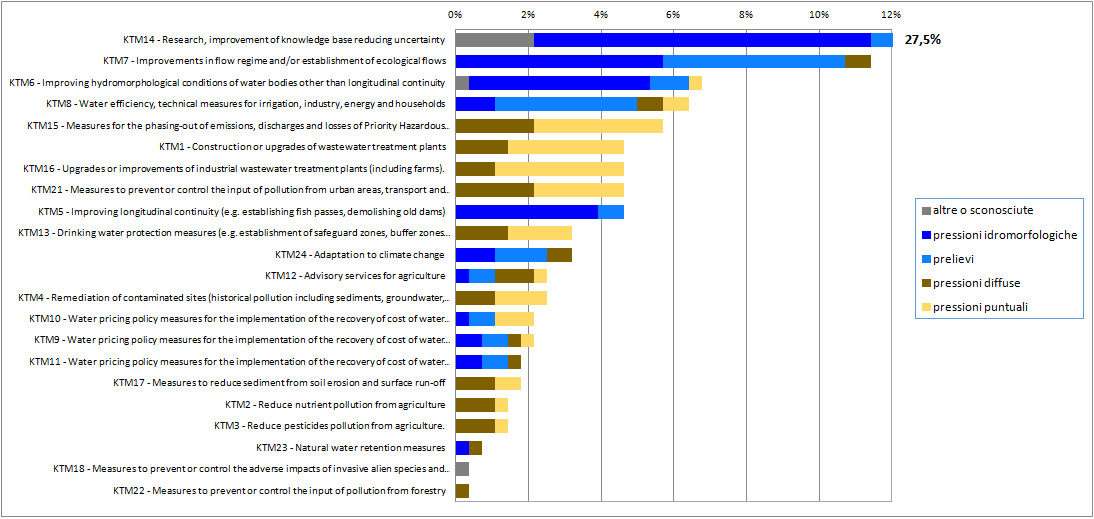
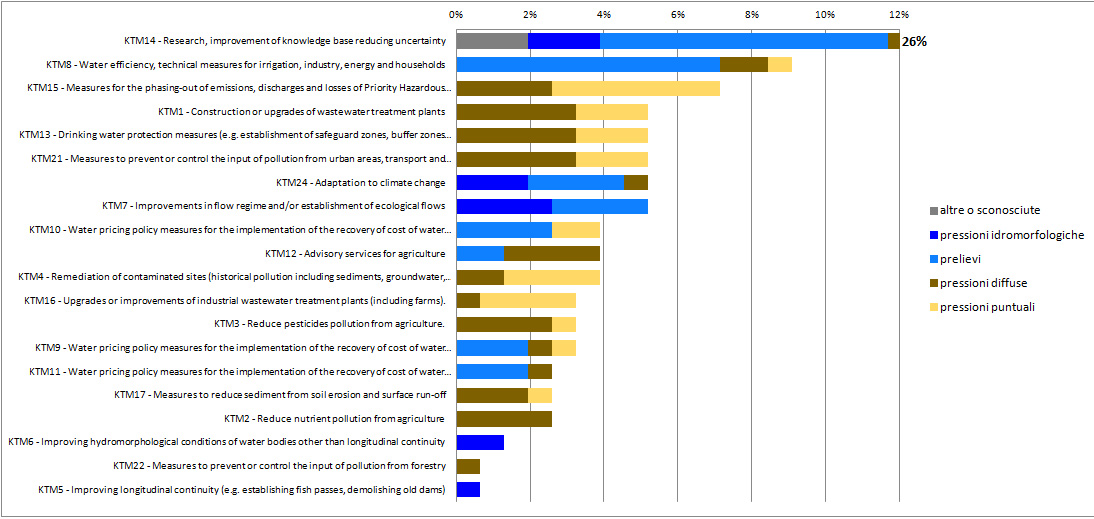
Each KTM serves to mitigate the impact of one or more pressures, and it is possible to link them to each other. In other words, for each KTM, the percentage of significant pressure types these measures aim to mitigate can be represented (Figure 2, Figure 3). However, data for this representation are available for only 4 out of 8 districts, resulting in a partial representation.
The most frequent measures for surface water bodies (Figure 2) are related to improving hydromorphological conditions, particularly concerning hydrological regimes. The most common example is the release of ecological flows to ensure environmental objectives are met for downstream water bodies and/or balance the hydrological budget. This is followed by morphological rehabilitation measures and the restoration of hydro-biological continuity (e.g., fish ladders).
Basic measures are predominant (e.g. treatment plants; reduction of nutrient loads). It is worth mentioning that, in compliance with the joint implementation of Water Management Plans and Flood Risk Management Plans, the so-called win-win measures are included in the plans, such as natural runoff retention measures, which are favourable both for achieving ecological quality and reducing flood risks.
The most frequent measures for groundwater bodies (Figure 3) aim at more sustainable use of water resources and rebalancing the water budget through improving usage systems' efficiency (e.g. innovative irrigation systems) and reducing withdrawals from springs, which are considered groundwater body emergencies. Particular attention is given to reducing or eliminating emissions of priority substances as outlined in Article 78 of Legislative Decree 152/06 and subsequent amendments.
For both categories of water bodies, the most used measures involve knowledge activities (KTM 14) with values of 28% for surface waters and 26% for groundwater.