Camilla Antonini, Saša Raicevich
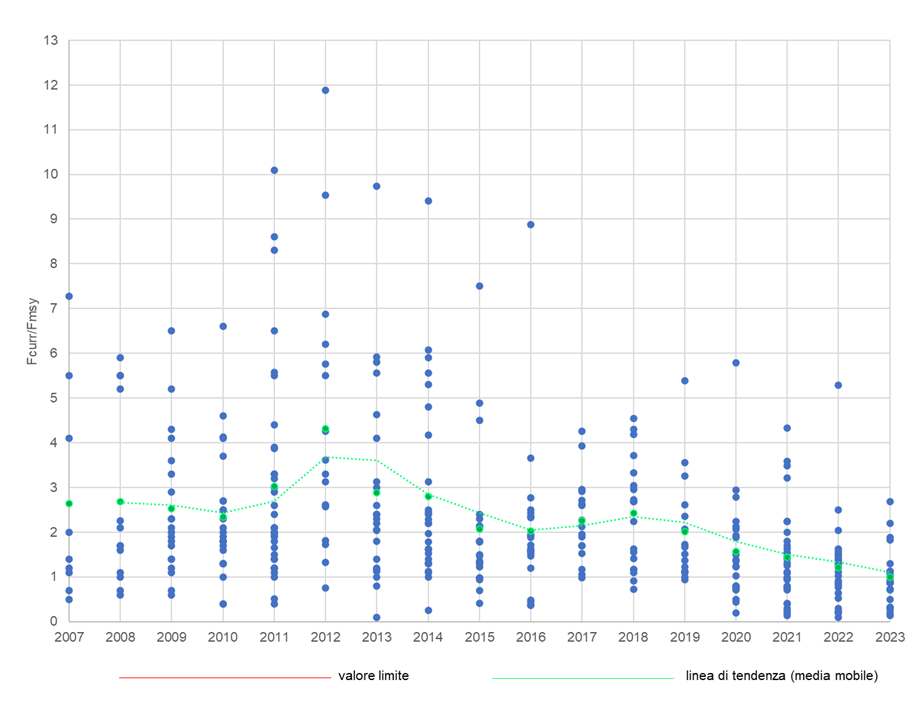
During the period considered (2007–2023), the average exploitation rate of fish stocks — expressed as the mean ratio between current fishing mortality and that corresponding to the Maximum Sustainable Yield (Fcurr/FMSY) — remained generally above the sustainability threshold.
The indicator, derived from analytical stock assessments validated at the international level, describes the overall trend in fishing pressure exerted on commercially exploited stocks.
Within the time series, 2023 stands out as the only year in which the Fcurr/FMSY value fell below the threshold of 1 (0.99), confirming the progressive downward trend observed in recent years for this indicator.
The indicator illustrates the trend in the average ratio between current fishing mortality and the mortality corresponding to the Maximum Sustainable Yield (FMSY or its proxies, such as F0.1, EMSY = 0.4, or other equivalents) for national fish stocks.
This parameter is estimated using a modelling approach based on established procedures and incorporates biological and catch data for the species considered.
Only fish stocks that have been analytically assessed and whose results have been internationally validated by EU technical bodies — the Scientific, Technical and Economic Committee for Fisheries (STECF) — and by the General Fisheries Commission for the Mediterranean (GFCM) are included.
Since stock assessments generally refer to years preceding the assessment itself, stock status is conventionally assigned to the year before the consolidation of the international evaluation.
A national-level assessment is provided, covering all seven Geographical Sub-Areas (GSAs) adopted as management units by the FAO–GFCM for Italian waters: GSAs 9, 10, 11, 16, 17, 18, and 19. Separate estimates are also presented for pelagic fish, demersal fish, and crustaceans.
Part of the assessed stocks are shared among several countries — both EU and non-EU — and the pool of assessed stocks varies from year to year.
The indicator is also linked to the analysis of annual EU landings for the stocks considered, providing key information for interpreting the results and identifying knowledge gaps at the national level.
To show the overall trend in the exploitation rate of commercially fished stocks in relation to sustainability objectives.
At both the international and EU levels, specific objectives for fisheries sustainability have been established.
Progress toward these goals can be tracked using this indicator as a proxy for the sustainability of resource exploitation.
Key references include:
- Directive 2008/56/EC of the European Parliament and of the Council of 17 June 2008, establishing a framework for community action in the field of marine environmental policy (Marine Strategy Framework Directive).
According to this Directive and the associated methodological standards (Commission Decision (EU) 2017/848 of 17 May 2017), under Descriptor 3 – Selective extraction of species, the following sustainability criteria apply:- Criterion D3C1 – Primary: The fishing mortality rate of commercially exploited populations is equal to or below the level capable of producing the Maximum Sustainable Yield (MSY).
- Criterion D3C2 – Primary: The spawning stock biomass of commercially exploited populations is above the level capable of producing the MSY.
- Regulation (EU) No. 1380/2013 of the European Parliament and of the Council of 11 December 2013 on the Common Fisheries Policy (CFP).
Article 2(2) states:
“The CFP shall apply the precautionary approach to fisheries management and shall aim to ensure that exploitation of living marine biological resources restores and maintains populations of harvested species above levels capable of producing the maximum sustainable yield. To achieve this objective, the MSY exploitation rate shall be achieved by 2015 where possible, and progressively by 2020 at the latest for all stocks.” - Aichi Biodiversity Target 6:
By 2020, all fish, invertebrate, and aquatic plant stocks are managed and harvested sustainably and legally, applying an ecosystem-based approach, ensuring that overfishing is avoided, recovery plans for depleted species are implemented, and fishing does not cause significant adverse impacts on threatened species or vulnerable ecosystems. - UN Sustainable Development Goal 14.4:
By 2020, effectively regulate harvesting and end overfishing, illegal, unreported and unregulated (IUU) fishing, and destructive fishing practices through science-based management measures, so as to restore fish stocks to levels that can produce MSY according to their biological characteristics.
The associated indicator — “Proportion of fish stocks within biologically sustainable levels” — measures the sustainability of global fisheries based on stock abundance. Stocks whose biomass is at or above the MSY level are classified as biologically sustainable.
Scientific, Technical and Economic Committee for Fisheries (STECF) – 2017 Mediterranean Stock Assessments - Part I (STECF-17-15). Publications Office of the European Union, Luxembourg, 2017, ISBN 978-92-79-67487-7, doi:10.2760/897559, JRC109350
Scientific, Technical and Economic Committee for Fisheries (STECF) - 2017 Mediterranean Stock Assessments - Part 2 (STECF-17-15); Publications Office of the European Union, Luxembourg, ISBN 978-92-79-67494-5, doi:10.2760/90316, JRC111820
Scientific, Technical and Economic Committee for Fisheries (STECF) – 56th Plenary Meeting Report (PLEN-17-03); Publications Office of the European Union, Luxembourg; ISBN 978-92-79-77297-9, doi:10.2760/605712, JRC109344
Scientific, Technical and Economic Committee for Fisheries (STECF) – 57th Plenary Meeting Report (PLEN-18-01), Publications Office of the European Union, Luxembourg, 2018, ISBN 978-92-79-85804-8, doi:10.2760/088784, JRC111800
Scientific, Technical and Economic Committee for Fisheries (STECF) – 2018 Mediterranean Stock Assessments - Part 1 (STECF-18-12). Publications Office of the European Union, Luxembourg, 2018, ISBN 978-92-79-79395-0, doi:10.2760/838965, JRC114779
Scientific, Technical and Economic Committee for Fisheries (STECF) – 2018 Mediterranean Stock Assessments - Part 2 (STECF-18-16). Publications Office of the European Union, Luxembourg, 2018, ISBN 978-92-79-79399-8, doi:10.2760/598716, JRC114787
Scientific, Technical and Economic Committee for Fisheries (STECF) – Stock Assessments: demersal stocks in the western Mediterranean Sea (STECF-19-10). Publications Office of the European Union, Luxembourg, 2019, ISBN 978-92-76-11288-4, doi:10.2760/5399, JRC119055
Scientific, Technical and Economic Committee for Fisheries (STECF) – 2019 Stock Assessments part 2: European fisheries for demersal species in the Adriatic Sea (STECF-19-16). Publications Office of the European Union, Luxembourg, 2019, ISBN 978-92-76-14558-5, doi:10.2760/95875, JRC119057
Scientific, Technical and Economic Committee for Fisheries (STECF) – Stock Assessments: demersal stocks in the western Mediterranean Sea (STECF-20-09). EUR 28359 EN, Publications Office of the European Union, Luxembourg, 2020, ISBN 978-92-76-27165-9, doi:10.2760/286667, JRC122993
Scientific, Technical and Economic Committee for Fisheries (STECF) – Stock Assessments in the Mediterranean Sea - Adriatic, Ionian and Aegean Seas (STECF-20-15). EUR 28359 EN, Publications Office of the European Union, Luxembourg, 2020, ISBN 978-92-76-27168-0, doi:10.2760/877405, JRC122994 FAO. 2020.
The State of Mediterranean and Black Sea Fisheries 2020. General Fisheries Commission for the Mediterranean. Rome. Https://doi. org/10.4060/cb2429en Scientific, Technical and Economic Committee for Fisheries (STECF) – Stock assessments in the Mediterranean Sea 2021 – Adriatic and Ionian Seas (STECF-21-15). EUR 28359 EN, Publications Office of the European Union, Luxembourg, 2021, ISBN 978-92-76-46195-1, doi:10.2760/59806, JRC127766.
Scientific, Technical and Economic Committee for Fisheries (STECF) – Stock Assessments: demersal stocks in the western Mediterranean Sea (STECF-21-11). Publications Office of the European Union, Luxembourg, 2021, EUR 28359 EN, ISBN 978-92-76-46116-6, doi:10.2760/046729, JRC127744
Scientific, Technical and Economic Committee for Fisheries (STECF) – Methods for supporting stock assessment in the Mediterranean (STECF-21-02). Publications Office of the European Union, Luxembourg, 2021, EUR 28359 EN, ISBN 978-92-76-40594-8, doi:10.2760/457201, JRC126125. Technical and Economic Committee for Fisheries (STECF) Quality checking of MED & BS data and reference points (STECF-22-03). Publications Office of the European Union, Luxembourg, 2023, doi:10.2760/465703, JRC130288.
Scientific, Technical and Economic Committee for Fisheries (STECF) – Stock Assessments: demersal stocks in Adriatic, Ionian and Aegean Seas and straits of Sicily (STECF-22-16). Publications Office of the European Union, Luxembourg, 2023, doi:10.2760/25344, JRC132157.
Scientific, Technical and Economic Committee for Fisheries (STECF) – Stock Assessments: demersal stocks in Adriatic, Ionian and Aegean Seas and straits of Sicily (STECF-22-16). Publications Office of the European Union, Luxembourg, 2023, doi:10.2760/25344, JRC132157.
Scientific, Technical and Economic Committee for Fisheries (STECF) - Stock assessments in the Western Mediterranean Sea (STECF 23-09), Mannini, A., Ligas, A. And Pierucci, A. Editor(s), Publications Office of the European Union, Luxembourg, 2023, doi:10.2760/995295, JRC135661.
Scientific, Technical and Economic Committee for Fisheries (STECF) - Stock Assessments in the Adriatic, Ionian and Aegean Seas and Strait of Sicily (STECF-23-12), Publications Office of the European Union, Luxembourg, 2023.
Scientific, Technical and Economic Committee for Fisheries (STECF) - Methodologies for Mediterranean stock assessments and the estimation of reference points (STECF- 24-02), Publications Office of the European Union, Luxembourg, 2024.
General Fisheries Commission for the Mediterranean (GFCM) - Report of Seventh Meeting of the Subregional Committee for the Western Mediterranean (SRC-WM), Rome, Italy, 21–24 May 2024. P. 116.
General Fisheries Commission for the Mediterranean (GFCM) - Report of Seventh Meeting of the Subregional Committee for the Adriatic Sea (SRC-AS), Podgorica, Montenegro, 28–31 May 2024. P. 131.
General Fisheries Commission for the Mediterranean (GFCM) - Report of Seventh Meeting of the Subregional Committee for the Adriatic Sea (SRC-AS), Rome, Italy (hybrid), 13–15 May 2025. P. 165.
General Fisheries Commission for the Mediterranean (GFCM) - Report of Seventh Meeting of the Subregional Committee for the Central Mediterranean (SRC-CM), Palermo, Italy (hybrid), 8–10 April 2025. P. 97.
General Fisheries Commission for the Mediterranean (GFCM) - Report of Seventh Meeting of the Subregional Committee for the Eastern Mediterranean (SRC-EM), Rome, Italy, 23–25 April 2025. P. 93.
General Fisheries Commission for the Mediterranean (GFCM) - Report of Seventh Meeting of the Subregional Committee for the Western Mediterranean (SRC-WM), Malaga, Spain, 27–29 May 2025. P. 90.
General Fisheries Commission for the Mediterranean (GFCM) - Report of Working Group on Stock Assessment in Demersal Species (WGSAD) Benchmark assessment for Norway lobster in the Adriatic Sea, Split, Croatia, 14–17 April 2025. P. 10.
General Fisheries Commission for the Mediterranean (GFCM) - Report of Working Group on Stock Assessment of Small Pelagic Species (WGSASP) Session on small pelagic species in the Adriatic Sea (GSAs 17–18), Online, 5–9 May 2025. P. 78.
European Commission, Joint Research Centre, Scientific, Technical and Economic Committee for
Fisheries (STECF) – Ad-hoc hake assessment (STECF-25-06).
European Commission: Joint Research Centre, Scientific, Technical and Economic Committee for Fisheries Methodologies for Mediterranean Stock Assessments (STECF-25-01). Jardim, E., Mantopoulou Palouka, D., and Gras, M. Editors, Publications Office of the European Union, Luxembourg, 2025, https://data. europa. eu/doi/10.2760/1568886, JRC142274.
The indicator is influenced by both the number and the type of stocks assessed.
The available assessments represent, on average, less than 50% of total national landings.
To improve temporal and spatial comparability, it is necessary to consolidate the stock assessment process for a stable set of fish stocks, as foreseen by the GFCM under the Data Collection Reference Framework (DCRF).
Analytical efforts should aim to cover a larger share of national landings, thereby allowing more comprehensive tracking of fishing pressure and stock status.
At the Mediterranean level, a coordinated approach should be established for selecting reference points, defining the methodological approaches used to estimate them, and quantifying the uncertainty associated with those estimates.
EUROSTAT (Statistical Office of the European Communities)
GFCM (General Fisheries Commission for the Mediterranean)
STECF (Scientific, Technical and Economic Committee for Fisheries)
Stock assessment data validated internationally by STECF and GFCM (annual reports): https://stecf. jrc. ec. europa. eu/reports
http://www. fao. org/gfcm/activities/fisheries/stock-assessment/en/
Landed data of fish species from STECF and EUROSTAT via the EUMOFA platform (annual reports):
https://stecf. jrc. ec. europa. eu/dd/fleet
https://www. eumofa. eu/
National
2007-2023
For each year, the indicator considers the status of fish stocks whose assessments have been finalized and validated by STECF and/or GFCM.
The stock status is evaluated based on the ratio between current fishing mortality (Fcurr) and the corresponding reference value (FMSY).
As a proxy for FMSY, the value F0.1, obtained through Yield-per-Recruit analyses, is generally used.
Stocks with Fcurr > F0.1 are classified as overexploited, i.e. subject to fishing pressure exceeding that which allows attainment of MSY.
This methodological approach aligns with that applied by the GFCM at the Mediterranean scale, as described in The State of Mediterranean and Black Sea Fisheries 2020 (GFCM, 2020), thereby allowing direct comparison between national and regional estimates.
For small pelagic stocks (sardine and anchovy), where direct F estimates are not available, the exploitation rate (E = F/Z) is used instead.
The reference threshold EMSY = 0.4 (Patterson, 1992) is applied to identify overexploitation, unless alternative reference values are explicitly justified in the technical documentation. Stocks with E > EMSY are considered overexploited.
For some stocks, assessments cover multiple FAO Geographical Sub-Areas (GSAs) — sometimes including GSAs belonging to non-EU countries or multiple subregions.
Large pelagic stocks (bluefin tuna and swordfish) are excluded, as they are assessed internationally by ICCAT across broad geographic scales (Atlantic–Mediterranean and Mediterranean, respectively).
In 2023, the 27 fish stocks considered exhibited an average exploitation rate — expressed as the mean Fcurr/FMSY ratio — of 0.99, thus falling below the sustainability threshold (1.0).
During the last three years (2021–2023), the percentage of national landings covered by analytical stock assessments was the highest recorded (64.2%, 62%, and 70.8%, respectively), indicating an improvement in the knowledge base.
Although this represents encouraging progress in a highly multispecies context such as the Italian and Mediterranean fisheries, it highlights the need to continue expanding the number of assessed stocks, particularly those with the greatest contribution to national landings.
Between 2007 and 2023, the average exploitation rate of fish stocks remained at unsustainable levels.
However, after a peak in 2012–2013 (with values exceeding 3), a steady decline occurred, reaching a minimum of 0.99 in 2023.
Further monitoring will be necessary to confirm the persistence of this trend.
| Data |
|---|
Thumbnail
Headline
Figure 1: Ratio between Fishing Mortality and Fishing Mortality at Maximum Sustainable Yield (Fcurr/FMSY), Averaged by Species and GSA Data source
ISPRA elaboration based on internationally validated stock assessment data from STECF and GFCM Note
Updated as of December 2024. |
Thumbnail
Headline
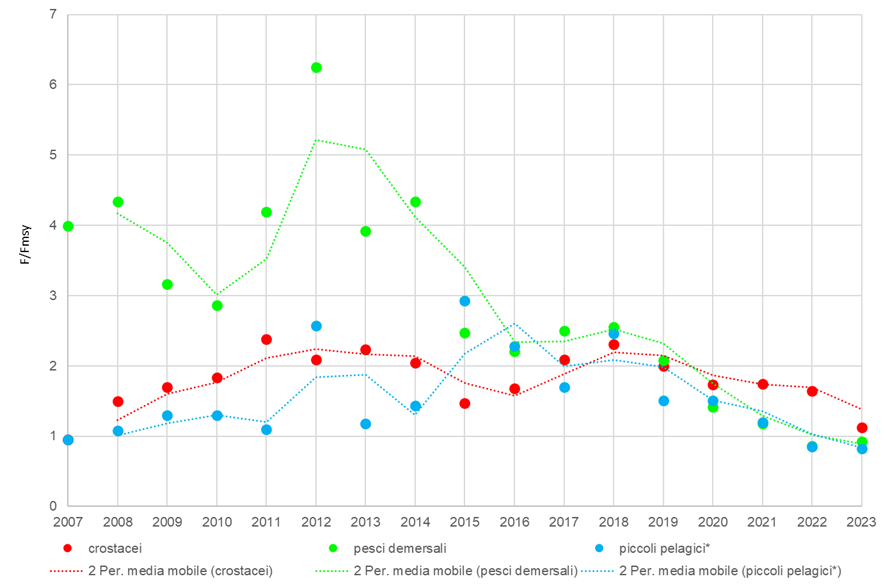
Figure 2: Overall Mean F/FMSY Value by Species Group Data source
ISPRA elaboration based on internationally validated stock assessment data from STECF and GFCM Data legend
*In the case of small pelagic stocks (sardine and anchovy), the exploitation rate (E = F/Z) is used. The reference threshold (EMSY) to define whether a stock is overexploited is set at 0.4, as suggested by Patterson (1992). When E > EMSY, the stocks are therefore classified as overexploited. Note
Updated as of December 2024 |
Thumbnail
Headline
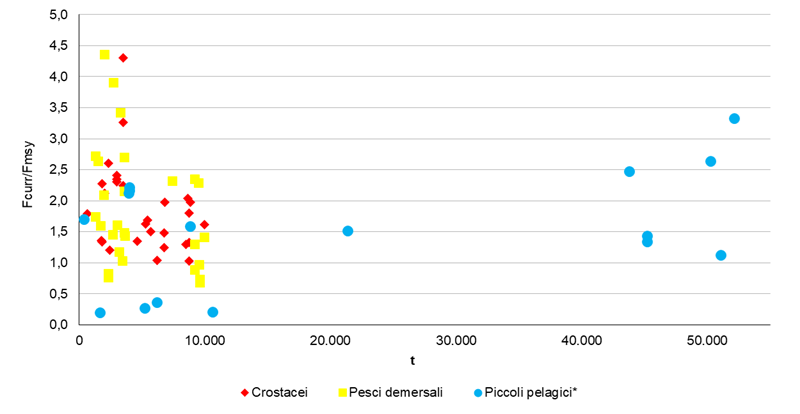
Figure 3: Annual Mean Value of the F/FMSY Ratio by Functional Group and GSA in Relation to Landings by GSA (Reference Year: 2018) Data source
ISPRA elaboration based on internationally validated stock assessment data from STECF and GFCM Data legend
*In the case of small pelagic stocks (sardine and anchovy), the exploitation rate (E = F/Z) is used. The reference threshold (EMSY) to define whether a stock is overexploited is set at 0.4, as suggested by Patterson (1992). When E > EMSY, the stocks are therefore classified as overexploited. Note
Updated as of December 2024 |
Thumbnail
Headline
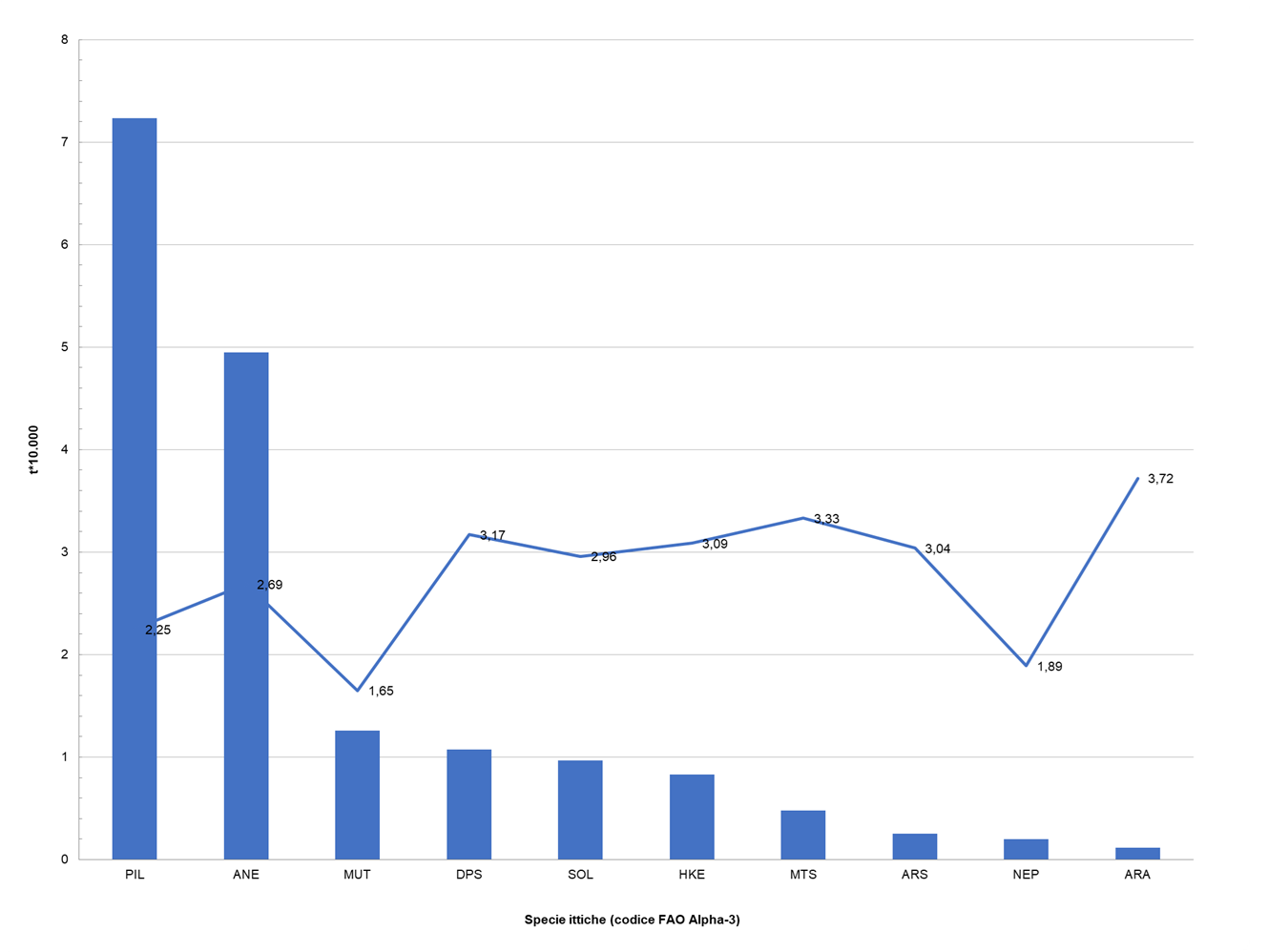
Figure 4: Landings by the EU Fishing Fleet for the Main Fish Species and Representation of the F/FMSY Ratio (Reference Year: 2018) Data source
ISPRA elaboration based on internationally validated stock assessment data from STECF and GFCM Data legend
PIL: Sardina pilchardus; ANE: Engraulis encrasicolus; MUT: Mullus barbatus; DPS: Parapenaeus longirostris; SOL: Solea solea; HKE: Merluccius merluccius; MTS: Squilla mantis; ARS: Aristaeomorpha foliacea; NEP: Nephrops norvegicus; ARA: Aristeus antennatus. Note
Updated as of December 2024 |
Between 2007 and 2023, the vast majority of assessed stocks were found to be overexploited.
When comparing annual landing quantities for the assessed stocks, no correlation emerges between landing volume and exploitation rate — reflecting a generally unsustainable status regardless of catch weight.
Figures report the ratio between the current exploitation rate and the reference value (Fcurr/FMSY or its proxies) — whether as point estimates, mean GSA values, or shared stock assessments.
Values greater than 1 indicate unsustainable exploitation, i.e. incompatible with achieving the Maximum Sustainable Yield.
Among species groups, demersal fish stocks show the steepest decline in mean Fcurr/FMSY over the period, whereas crustaceans and small pelagics exhibit relatively stable average values, both above the sustainability threshold.
In 2023, both pelagic and demersal fish showed average indicator values below 1.00, while crustaceans remained above this threshold.
When related to EU landings by species group within Italian GSAs, crustaceans and demersal fish generally represent smaller landing volumes than pelagic fish, yet show higher Fcurr/FMSY ratios.
Overall, the general condition of overexploitation of the main stocks appears to be independent of landing volumes.