Tomaso Fortibuoni
Ocean warming is causing a geographical and depth shift in marine species more sensitive to temperature changes. In temperate zones, such as the Mediterranean, this phenomenon results in a northward expansion of warm-affinity species. Consequently, the composition of marine communities changes, affecting commercial fishery landings.
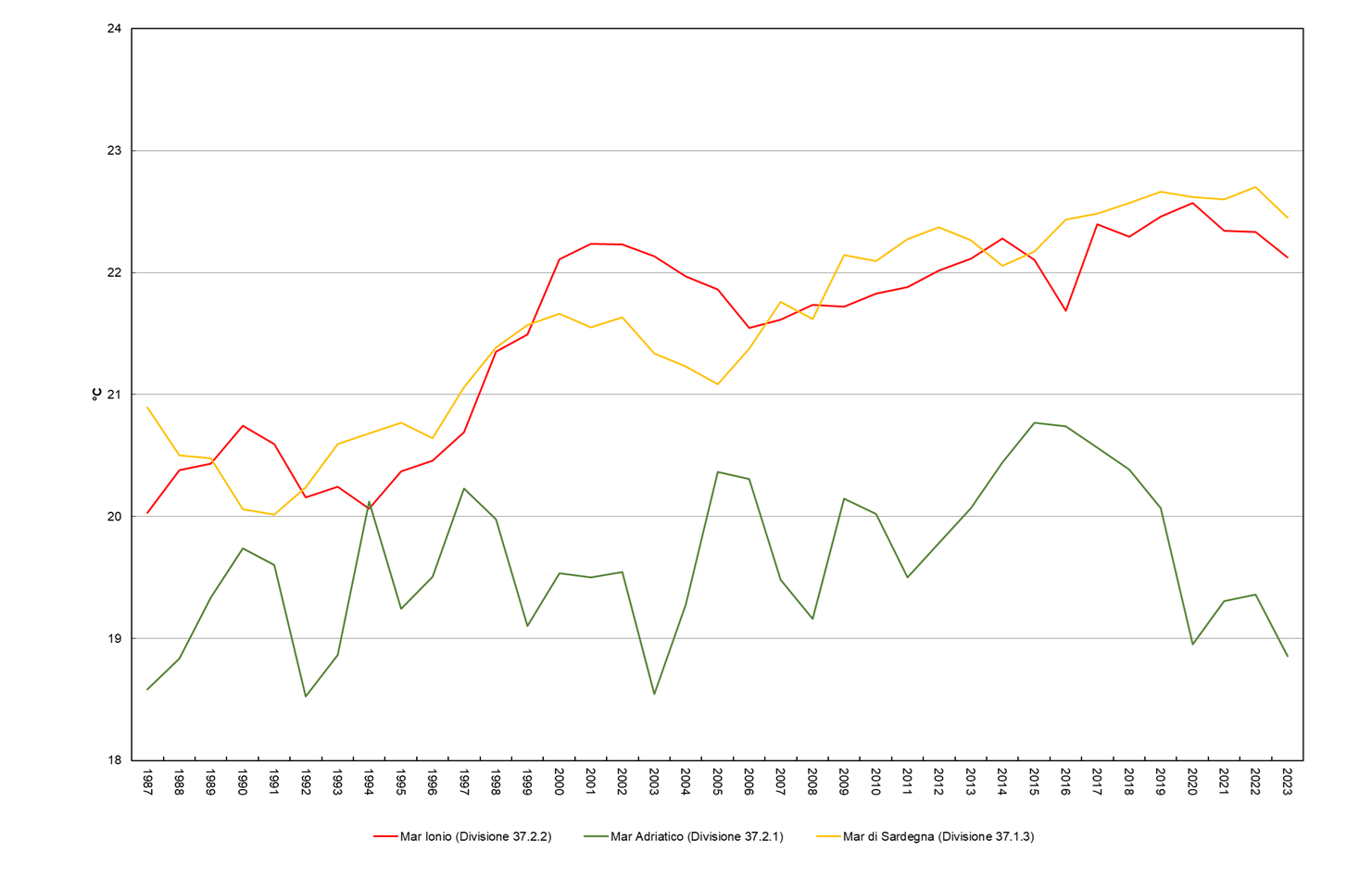
This phenomenon is described by an indicator known in scientific literature as the “Mean Temperature of the Catch (MTC),” which represents the average thermal affinity of commercial fishing catches. In the Adriatic Sea (FAO Division 37.2.1), the average thermal affinity of the catches of Italian fleets increased from 19.2 °C (average 1987–1996) to 20 °C (average 2013–2023), with a significant annual increase of 0.03 °C; in the Ionian Sea – Central Mediterranean (FAO Division 37.2.2), it increased from 20.3 to 22.2 °C, with a significant annual increase of 0.07 °C; in the Sea of Sardinia – Western Mediterranean (FAO Division 37.1.3), from 20.5 to 22.5 °C, with a significant annual increase of 0.07 °C.
Cold-blooded marine species, such as commercially exploited fish, exhibit a preferred temperature range dictated by their physiological characteristics. Each species has a geographical distribution aligned with its thermal requirements.
The MTC indicator is calculated as the average of the preferred temperatures of species present in commercial fishery landings in a given year, weighted by the landing of each species.
A rising MTC over time indicates a relative increase in warm-affinity species compared to cold-affinity species in commercial fisheries.
The preferred temperatures used for MTC calculation are sourced from Cheung et al. (2013), while the commercial fishery data are based on official FAO-GFCM fishing statistics.
To track the impact of the phenomenon known as "meridionalisation" of marine communities over time - i.e., the relative increase in warm-affinity species at the expense of cold-affinity species due to ocean warming - and its effects on commercial fisheries.
None
Ben Rais Lasram, F., Guilhaumon, F., Albouy, C., Somot, S., Thuiller, W., & Mouillot, D. (2010). The Mediterranean Sea as a ‘cul-de-sac’ for endemic fishes facing climate change. Global Change Biology, 16(12), 3233–3245.
Cheung W.W.L., Watson R., and Pauly, D. 2013. Signature of ocean warming in global fisheries catch. Nature, 497: 365–368. Cheung, W.W.L., and Pauly, D. 2016. Explaining Ocean Warming: Causes, scale, effects and consequences. IUCN, International Union for Conservation of Nature. 289–302 pp. https://portals.iucn.org/library/node/46254.
Fortibuoni T., Aldighieri F., Giovanardi O., Pranovi F., and Zucchetta M. 2015. Climate impact on Italian fisheries (Mediterranean Sea). Regional Environmental Change, 15: 931–937.
Leitão F., Maharaj R.R., Vieira V.M.N.C.S., Teodósio A., and Cheung, W.W.L. 2018. The effect of regional sea surface temperature rise on fisheries along the Portuguese Iberian Atlantic coast. Aquatic Conservation: Marine and Freshwater Ecosystems, 28: 1351–1359.
Tsikliras A.C., and Stergiou K.I. 2014. Mean temperature of the catch increases quickly in the Mediterranean Sea. Marine Ecology Progress Series, 515: 281–284.
Landings and preferred temperature data are available only for a limited number of commercially relevant species, approximately twenty.
FAO-GFCM fishery statistics are aggregated at the division level (Adriatic Sea, Ionian Sea, Sardinian Sea), making it impossible to analyse potential local-scale changes in the indicator.
The use of fishery independent data (i.e., from scientific monitoring and not from commercial fishing) would also allow species of low commercial value but sensitive to temperature, and alien species, to be considered in the estimation of the indicator.
GFCM (General Fisheries Commission for the Mediterranean)
National
1987-2023
The MTC (Mean Temperature of the Catch) indicator is calculated as the weighted average of the preferred temperatures of the species composing the landed catch in a given year, where the weights correspond to the commercial landing of each species in that year.
The preferred temperatures used in the indicator's calculation are derived from the study by Cheung et al. (2013), while fishing catch data comes from the official FAO-GFCM statistics.
The temporal trend is evaluated using the Mann-Kendall test, which statistically assesses whether there is a positive or negative monotonic trend in the variable of interest over time. A positive (negative) monotonic trend means that the variable can only increase (decrease) over time, either linearly or nonlinearly.
In 2023, compared to the previous year, a decrease in MTC of 0.5 °C was observed in the Adriatic Sea and of 0.2 °C in the Ionian Sea and Central Mediterranean. This represents a slight reversal of the trend compared to the previous year and to historical series, potentially linked to fluctuations in catches that go beyond the effect of climate change.
The indicator increases significantly in all three FAO divisions into which the Italian seas are divided, as a consequence of an increase in commercial catches of warm-affinity species compared to cold-affinity species.
This results in a negative trend in terms of the state of fishery resources, whose composition is changing as a likely consequence of sea warming.
In the Sea of Sardinia and the Ionian Sea, an increase of almost 2 °C in the mean temperature of catches has been recorded from the beginning (1987–1996) to the end (2013–2023) of the historical series, at a rate of about 0.07 °C per year.
In the Adriatic Sea, the increase from the first period of the historical series to today has been nearly 1 °C, with an annual increase of 0.03 °C.
| Allegati |
|---|
Thumbnail
Titolo
Figure 1: Annual trend of the Mean Temperature of the Catch (MTC) indicator representing the average thermal affinity of the catches of the commercial fisheries of the Italian fleets in the three FAO divisions into which the Italian seas are divided Fonte
FAO-GFCM. 2025. Fishery and Aquaculture Statistics. GFCM capture production 1970-2023 (FishStatJ). In: FAO Fisheries and Aquaculture Division [online]. Rome. Updated 2025. www.fao.org/fishery/en/statistics/software/fishstatj Cheung WWL, Watson R, Pauly D (2013) Signature of ocean warming in global fisheries catch. Nature 497: 365–369. doi:10.1038/nature12156 |
Figure 1 illustrates the ongoing "meridionalisation" of Italian seas—this refers to the expansion of thermophilic (warm-affinity) marine organisms that are typically found in the southern Mediterranean but are now shifting their ranges northward into temperate regions where they were previously absent or rare.
This phenomenon directly affects commercial fishery catches, leading to a relative increase in warm-affinity species over cold-affinity species and, consequently, a rise in the MTC indicator.
Notably, the annual MTC increase in the Adriatic Sea is almost half that observed in the other two areas.
This slower rise may be attributed to the Adriatic being the northernmost and coldest basin of the Mediterranean. Within certain limits of marine temperature increase, the Adriatic could be a refuge for cold-affinity species (Ben Rais Lasram et al., 2010).
The hypothesis that, by 2050, the Adriatic could become a "cul-de-sac" for cold-affinity species (Ben Rais Lasram et al., 2010) can only be validated with a longer dataset and further analyses.