Antonella Bernetti
The indicator evaluates greenhouse gas emissions produced by the transport sector to verify the achievement of national and international objectives. In 2024 in Italy, transport is responsible for 31.2% of total greenhouse gas emissions. In the period 1990 - 2019, emissions from the transport sector (excluding international transport/bunkers) grew by 4.0%; in 2020 there was a marked reduction (-18.6% compared to 2019) fundamentally attributable to the mobility restriction measures due to the pandemic crisis, subsequently, from 2020 to 2021, there was an increase in emissions equal to 18.9%. From 2022 there will be a return to pre-pandemic levels. Overall, sector emissions from 1990 to 2024 increase by 10.9%. Various critical issues characterize the national transport system, which is far from the ambitious 2030 and 2050 objectives for reducing greenhouse gas emissions at a European level.
The increasing concentrations of greenhouse gases in the atmosphere lead to significant alterations in global temperatures and the Earth's climate, as well as potential damage to ecosystems, human settlements, agriculture and socio-economic activities. The indicator considers the atmospheric emissions of the three main greenhouse gases, namely carbon dioxide (CO 2), methane (CH 4) and nitrous oxide (N 2 OR); the other regulated greenhouse gases (hydrofluorocarbons, perfluorocarbons and sulfur hexafluoride) are not relevant to the transport sector.
Evaluate the greenhouse gas emissions produced by the transport sector, in order to verify the achievement of national and international objectives for reducing the related emissions.
The evolution of international climate policies traces a path of growing ambition: from the foundations of the UNFCCC in 1992, we moved on to the emission reduction constraints of the Kyoto Protocol (1997) and the Doha Amendment (2012), up to the decisive turning point of the Paris Agreement of 2015, which commits the world to limiting the increase in global temperature to within 1.5-2 °C compared to pre-industrial levels.
At a national level, the control architecture has adapted to the international framework through the MASE, which entrusts ISPRA with the annual updating of the greenhouse gas inventory through the National System established by Legislative Decrees 51/2008 and 30/2013. Subsequently, Law 79/2016 integrated these functions by defining the national low emissions strategy and synergizing data communication with European Governance (EU Regulation 2018/1999), whose progress is formalized in the National Integrated Plan for Energy and Climate (PNIEC).
The European approach underwent an extraordinary acceleration with the launch of the European Green Deal and the subsequent European Climate Law of 2021, which transformed the objective of climate neutrality by 2050 into a legally binding obligation. This paradigm shift has made obsolete the old goals of the 2030 Framework approved in 2014, which envisaged a 40% cut in emissions, a 32% share of renewables and 32.5% efficiency gains. Through the "Fit for 55" legislative package and the RED III Directive, the European Union has raised its objectives for 2030, requiring a net reduction in greenhouse gases of at least 55% compared to 1990, bringing the binding target share for renewable energy to 42.5% of gross final consumption and imposing an 11.7% contraction in global energy consumption.
Within this collective effort, sectors not covered by the emissions trading system, such as transport, housing, agriculture and waste, are governed by the principle of effort sharing. If historically the 2009 Effort Sharing Decision assigned Italy a reduction target of 13% by 2020 compared to 2005, and the subsequent 2018 Regulation raised the bar to 33% for 2030, the recent and definitive revision of the Effort Sharing Regulation (ESR) has recalibrated the national targets. For Italy, the binding reduction obligation for 2030 has been drastically raised to -43.7%, imposing a profound economic and infrastructural restructuring in all affected sectors.
The transport sector represents the most sensitive axis of this transition, with the long-term objective of reducing its emissions by 90% by 2050, exceeding the old indicative guidelines expressed by the 2011 White Paper. For light vehicles, the stages set by the historic regulations of 2009 and 2011 have merged into EU Regulation 2019/631, in turn superseded by the EU Regulation 2023/851. Quest'ultimo testo delineava originariamente lo stop totale alla vendita di nuove auto a combustione interna entro il 2035, ma la normativa è stata recentemente aggiornata per accogliere il principio di neutralità tecnologica. The new orientation sets a target of 90% reduction in exhaust emissions by 2035, allowing the remaining 10% to be filled through the use of synthetic fuels and advanced biofuels, while for the transitional period manufacturers benefit from greater flexibility in calculating CO2 averages to avoid immediate sanctions in a phase of complex fluctuations in the electricity market.
Finally, the heavy and commercial transport segments have also seen crucial updates that go beyond the confines of the old 2009 Fuel Quality Directive. EU Regulation 2024/1610 has tightened the parameters for heavy vehicles, imposing CO2 reduction trajectories of 45% by 2030 and 90% by 2040, with the specific goal of zero emissions for new city buses already in 2035, mitigated only by more elastic mechanisms in the accumulation and compensation of emission credits among manufacturers. At the same time, the new rules on the circular economy impose minimum quotas of recycled plastic in the production of vehicles, while maritime transport, once excluded from stringent policies, has been fully integrated into the EU Maritime ETS system and bound by the FuelEU Maritime regulation, which imposes a progressive reduction in the carbon intensity of naval fuels in European ports.
From 2027 the market phase will be activated with the auctioning of emission quotas (system known as ETS2), for the sectors: building heating, road transport and industrial sectors excluded from the current ETS mechanism.
In 2026, the new and ambitious binding objective of a 90% reduction in net greenhouse gas emissions by 2040 compared to 1990 was formalized at European level, in line with climate neutrality by 2050.
ISPRA, National inventory of atmospheric emissions, 2026, https://emissioni. sina. isprambiente. it/economia-nazionale/
ISPRA, Italian Greenhouse Gas Inventory 1990-2024, National Inventory Document 2026, Reports 428/2026,
European Commission, Communication from the Commission to the European Parliament, the Council, the European Economic and Social Committee and the Committee of the Regions “A Roadmap for moving to a competitive low carbon economy in 2050”, COM(2011) 112, 8.3.2011
European Commission, Energy Roadmap 2050 (COM(2011) 885/2)
European Commission, The European Green Deal, COM(2019) 640 final
European Commission, White Paper on the Future of Europe - Reflections and scenarios for the EU27 by 2025, COM(2017)2025 of 1 March 2017
European Commission, White Paper “Roadmap to a Single European Transport Area – Towards a competitive and resource efficient transport system”, COM(2011) 144, 28.3.2011
IPCC, 2006 IPCC Guidelines for National Greenhouse Gas Inventories, 2006
ISPRA, National inventory of atmospheric emissions, 2025, https://emissioni. sina. isprambiente. it/interno-nazionale/
ISPRA, Italian Greenhouse Gas Inventory 1990-2023, National Inventory Report 2025, Reports 411/2025,
MASE, National Integrated Plan for Energy and Climate (PNIEC) 2024, revised version 1 July 2024, https://www. mase. gov. it/portale/documents/d/guest/pniec_2024_revfin_01072024-errata-corrige-pulito-pdf
MASE, MIMIT, National energy balance, various years, https://dgsaie. mise. gov. it/ben. php
MIMIT, Guide to fuel savings and CO2 emissions, various years, https://www. mise. gov. it/index. php/it/mercato-e-consumatori/qualita-di-prodotti-e-servizi/auto-ed-emissioni-co2
-
EEA (European Environmental Agency), ISPRA (Higher Institute for Environmental Protection and Research), UNFCCC
EEA, Database on annual greenhouse gas emissions by Member State and category, https://www. eea. europa. eu/data-and-maps/data/data-viewers/greenhouse-gases-viewer
ISPRA, Data and publications on the historical series of emissions into the atmosphere, https://emissioni. sina. isprambiente. it/interno-nazionale/
UNFCCC, Database on annual greenhouse gas emissions by country and category, https://di. unfccc. int/detailed_data_by_party
EEA, European Environment Agency, Monitoring CO2 emissions from passenger cars, various years, https://www. eea. europa. eu/data-and-maps/data/co2-cars-emission-20
EEA, Database on annual greenhouse gas emissions by Member State and category, https://www. eea. europa. eu/data-and-maps/data/data-viewers/greenhouse-gases-viewer
UNFCCC, Database on annual greenhouse gas emissions by country and category, https://di. unfccc. int/detailed_data_by_party
National
1990 - 2024
The estimate of greenhouse gas emissions, required by the UN Framework Convention on Climate Change, is carried out starting from energy consumption using appropriate emission factors and applying sophisticated algorithms. European harmonized calculation models are used. Emissions are calculated based on the IPCC Guidelines of the Convention and refer only to domestic transport, excluding emissions from international bunkering.
A poor rating is given to the state due to the critical issues still linked to the national transport system, which is far from the ambitious 2030 and 2050 objectives for reducing greenhouse gas emissions at a European level. In Italy, greenhouse gas emissions from transport in 2024 represent 31.2% of the total emitted at a national level (Table 1). Transport, together with the energy industries, are the sectors most responsible for emissions. The road remains the prevalent mode and the use of fossil fuels is still predominant. Air transport, which has seen strong growth over the years, will only account for 2.1% of transport emissions in 2024 (data not shown in the table). In 2024, 66% of the sector's carbon dioxide emissions will be produced in passenger transport; the share due to road transport, of passengers and goods, is equal to 92.7% (Table 2). Greenhouse gas emissions from the transport sector, although reducing by 11.7% compared to 2005, in 2024 amount to 113,281.8 kt CO2 eq. The 2030 reduction objective set for Italy by the Effort Sharing Regulation (EU) 2023/857 is equal to -43.7% compared to 2005, for overall greenhouse gas emissions from the sectors: agriculture, civil, waste, transport and industrial plants not covered by the EU-ETS system. In 2024, the weight of transport on emissions deriving from all the sectors covered by the Effort Sharing Regulation (see Indicator "Greenhouse gas emissions in the ETS and ESD sectors") is equal to 42.4%; their contribution is therefore essential to achieving the objective set for 2030.
A negative assessment is given to the trend as greenhouse gas emissions from transport increase by 10.9% from 1990 to 2024 (Table 1). The evolution over time shows a trend linked to that of consumption: growth until 2007 and a subsequent decrease, except for the increases recorded in 2014, 2018, 2019, 2021, 2022 and 2024. The trend in emissions in the sector fundamentally reflects the trend in emissions from road transport, which constitutes the predominant share. The mode which records the greatest growth is the air one (data not shown in the table). The trend of the sector is attributable to the combined dynamics of passenger transport, of which private road transport is predominant, and of goods transport, still fundamentally linked to road transport which have been affected by the period of economic crisis since 2007, although showing a recovery in recent years. The growth seen over the years in transport demand, despite the periods of crisis, has counterbalanced the improvement achieved in the energy efficiency of means of transport and the increase in the use of fuels with lower emissions. At the overall European level (EU27), emissions from the transport sector show a growth from 1990 to 2024 of approximately 19.3%, although recording a decrease in the period 2008 – 2013, as well as in 2020 and 2023. Note that the group of Eastern European countries presents a more pronounced increase in emissions from transport compared to Western Europe (Table 3).
| Allegati |
|---|
File
Titolo
Tabella 1: Emissioni di gas serra dal settore dei trasporti per tipo di gas Fonte
ISPRA |
Titolo
Percentuale di emissioni di anidride carbonica per tipo di traffico e modalità di trasporto Fonte
ISPRA |
Titolo
Tabella 3: Emissioni di gas serra, negli altri paesi, causate dal settore trasporti Fonte
Agenzia Europea dell'Ambiente, UNFCCC |
Thumbnail
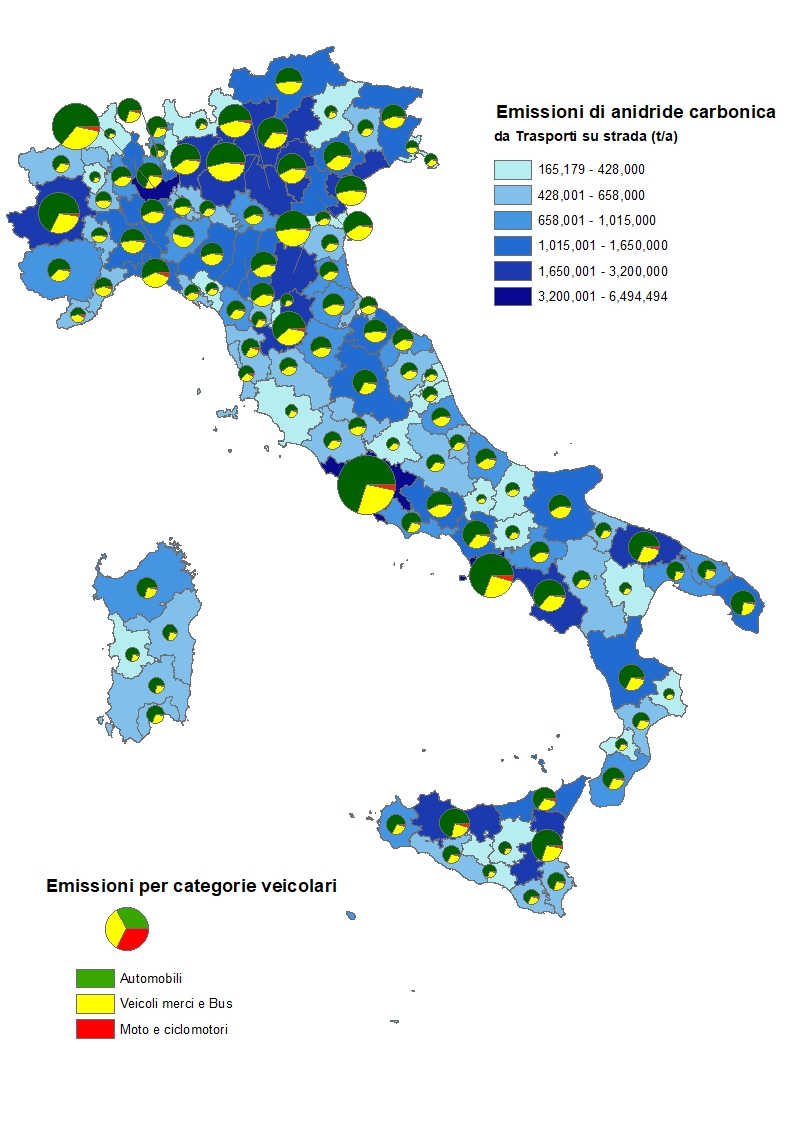
Titolo
Figura 1: Emissioni di CO2 dal settore trasporti (2024) Fonte
ISPRA |
Emissions in the sector (excluding international transport/bunkers) from 1990 to 2024 increased overall by 10.9%: from 1990 to 2019 they grew by 4.0%, in 2020 there was a sharp decline (-18.6%) fundamentally attributable to the pandemic, while the subsequent recovery involves an increase in emissions equal to 18.9% from 2020 to 2021 and equal to 10.1% from 2021 to 2024. Carbon dioxide emissions, which in 2024 constitute 99.0% of the sectoral total, are closely linked to energy consumption; the predominant share of emissions comes from road transport. The majority of emissions related to air traffic come from international flights, i. e. From planes that provide connections between EU states or between a Member State and a third country. The real impact of aeronautical emissions on global warming is however higher, as air transport affects the planet's climate by also releasing water vapor at high altitudes which can lead to the formation of condensation trails and cirrus clouds, with negative consequences on global warming. The reduction in overall methane emissions from transport is due to the combined effect on the one hand of technological improvements which limit emissions of volatile organic compounds from car exhaust pipes, and on the other to the expansion of the two-wheel fleet which produces an increase in emissions. Nitrous oxide emissions are linked to vehicle technology and connected to the use of catalytic converters.