Monica Pantaleoni, Antonio Caputo
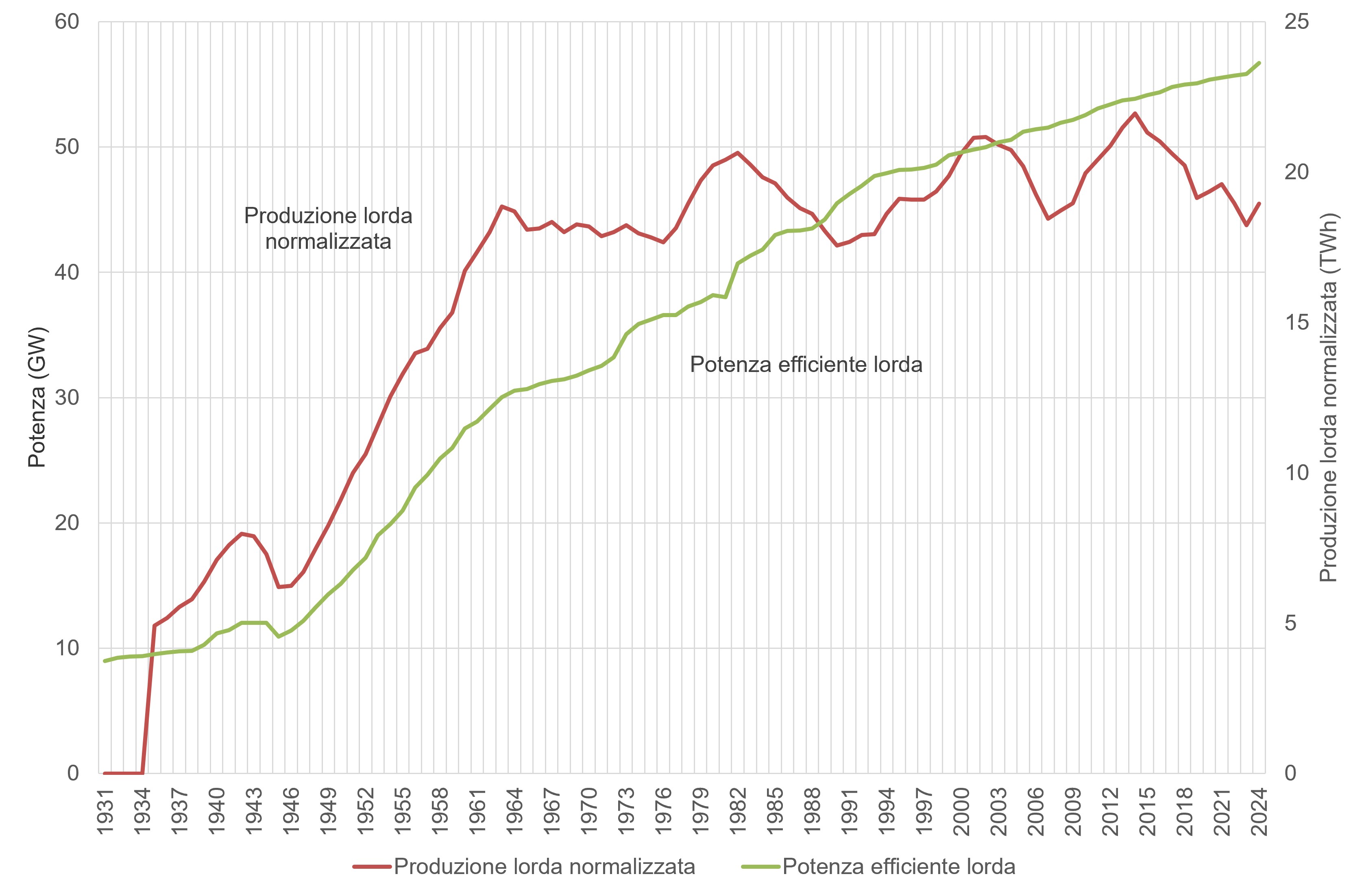
This indicator provides information on standardised gross hydroelectric power generation (in TWh) and gross effective capacity (in GW) in Italy, from 1931 to 2024, with the aim of analysing their trends over time and assessing any significant trends, including in relation to climate change. Hydropower generation is, in fact, an energy source that is heavily dependent on meteorological and climatic conditions, which have led – and will continue to lead over time – to a reduction in water availability and greater difficulties in managing it. When the effects of climate change are combined with the impact of human activities, future scenarios generally predict a decline in potential hydropower generation. Installed capacity has grown steadily from 3.7 GW in 1931 to reach 23.6 GW in 2024. Normalised hydroelectric generation rose from 11.8 TWh in 1935 to a peak of 52.7 TWh in 2014, before stabilising at levels between 43 and 47 TWh over the last decade, recording a figure of 45.5 TWh in 2024.
This indicator provides information on gross hydroelectric power generation in Italy. The data has been normalised – in accordance with the criteria set out in Directive 2009/28/EC (Annex II) – to smooth out annual fluctuations. For a more comprehensive interpretation, an analysis of installed capacity is also provided, expressed in terms of gross effective power (GW-electric).
To analyse trends in hydroelectric power generation in Italy, as a source that is heavily dependent on meteorological and climatic variables. This indicator is therefore of significant interest in the study of the impacts of climate change, as it can help to improve our understanding of the correlation between climatic phenomena, water resource management and the resulting dynamics relating to hydroelectric power generation.
The regulatory framework for the Italian hydroelectric sector has evolved through a complex layered legislative structure that balances the need for resource regulation, environmental protection and market liberalisation. The historical foundation is provided by Royal Decree 1775/1933, the Consolidated Act on Water and Electrical Installations, which has governed the granting of water diversion concessions for hydroelectric purposes for almost a century. This basic framework has gradually been supplemented by EU and environmental legislation, notably Directive 2000/60/EC (the Water Framework Directive), which introduced strict principles for the protection of water bodies and the obligation to comply with the Minimum Vital Flow (DMV) — now evolved into the concept of Ecological Flow —, directly affecting the operation and productivity of the plants. In the context of market reorganisation and sustainability, Legislative Decree 79/1999 (the Bersani Decree) and the subsequent Legislative Decree 152/2006 (the Consolidated Environmental Act) defined both the regulatory framework for hydroelectric concessions and the procedures for environmental impact assessments
The main limitation associated with this indicator relates to its interpretation, which must necessarily take into account the fact that it is also influenced by non-climatic factors. Nevertheless, it can be regarded as a useful indicator for assessing the impacts of climate change, in that it provides valuable insights for studying the effects on the hydroelectric sector.
Assessments of the correlation between the indicator and precipitation trends could help to provide a better understanding of the impact of this climatic variable on hydroelectric power generation.
Terna - Rete Elettrica Nazionale S. p. A.
Terna - Statistica annuale della produzione e del consumo di energia elettrica in Italia
National
1935-2024
The normalisation of hydroelectric generation data was carried out in accordance with the criteria set out in Directive 2009/28/EC (Annex II). Gross generation, including energy used for pumping, reflects the average generation over a five-year period.
Hydropower is historically the most mature and well-established renewable resource within Italy’s electricity generation mix, with a gross efficient capacity of 23.6 GW and an output of 45.5 TWh in 2024. Despite the continuous increase in installed capacity, the national hydropower sector is facing substantial saturation of sites that are geographically and ecologically suitable for large-scale plants. The share of generation is increasingly affected by climatic variability and the availability of water resources, with significant fluctuations between hydrologically favourable years and those marked by prolonged droughts.
The historical development can be divided into three main phases. An initial phase of strong expansion (1931–1960), coinciding with the country’s industrialisation, during which installed capacity tripled from 3.7 to 11.5 GW and generation exceeded 40 TWh. A second phase of moderate growth (1961–2010), characterised by the completion of large reservoirs and the commissioning of pumped-storage plants, with installed capacity rising from 11.7 to 21.9 GW. Finally, a third phase of stabilisation (2011–2024), during which installed capacity grew only marginally (from 22.1 to 23.6 GW) and generation has stabilised at an average of 46–48 TWh, highlighting that new increases in installed capacity consist mainly of small-scale plants (small-scale hydroelectric or ‘small-hydro’) and the repowering of existing facilities. During the period 1935–1963, installed capacity showed a steady increase and hydroelectric generation followed a parallel trend. Subsequently, cyclical fluctuations were observed around an average level of electricity generation, with a slight upward trend. Furthermore, Figure 1 shows that the ratio of generation to installed capacity has declined significantly, indicating the need for greater installed capacity per unit of generation. In the 1960s, the average ratio was approximately 3.4 TWh/GW, compared with a figure of 2.0 TWh/GW in the last five years. Since 2015, there has been a steady decline in hydroelectric generation, with the lowest figure recorded in 2022 at 30.3 TWh. The peak in generation was recorded in 2014 at 60.3 TWh.
| Data |
|---|
Headline
Table 1: Gross hydroelectric generation and installed capacity in Italy Data source
ISPRA analysis based on TERNA data |
Thumbnail
Headline
Figure 1: Gross hydroelectric generation and installed capacity in Italy Data source
ISPRA analysis based on TERNA data |
Trends in hydroelectric power generation can provide insights into changes in the hydrological cycle resulting from shifting climatic conditions, particularly when considered alongside changes over time in installed electricity generation capacity. Integrated water resource management will become increasingly crucial for balancing clean energy production with agricultural and domestic water use in the context of climate change.