Marina Vitullo
The indicator refers to carbon stock, i.e., the amount of carbon stored in Italy across the different forest carbon pools, and to the variation in carbon stock (carbon sink), which accounts for both the carbon sequestered and the emissions released due to wildfires, harvesting, and natural mortality within national forest ecosystems. Carbon stock and carbon sink are effective indicators for assessing the condition of a country’s forest resources, as they are influenced by forest productivity and, negatively, by both natural and anthropogenic disturbances (such as fires, logging, pests and pathogens, natural mortality, etc.).
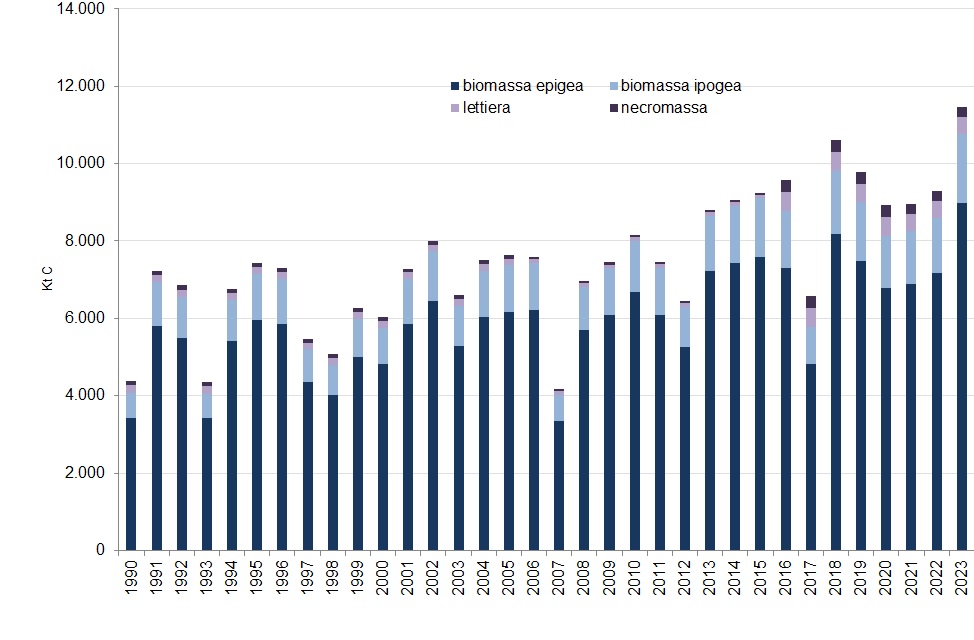
Carbon stocks in Italian forests are increasing, indicating a net positive balance between greenhouse gas (GHG) emissions and removals (carbon sink). This trend is partially driven by conservation and forest protection policies and, on the other hand, by a decrease in harvested timber volumes due to complex economic and social factors. Emissions from forest fires remain a significant concern. The trend of the national carbon sink over the period 1990–2023 has been heavily affected by a reduction in GHG removals associated with areas burned annually. In fact, the impact of biomass loss from large-scale wildfires in 1990, 1993, 2007, and 2017 is particularly evident in the carbon sink trend. This highlights the critical role of wildfires in shaping the contribution of national forests to the global carbon cycle
Forests play a key role in the global carbon cycle. They represent the biome with the highest carbon density, ranging from a few dozen to several hundred tonnes of carbon dioxide (CO₂) per hectare. Additionally, forests are the most widespread biome on Earth, covering approximately 3.9 billion hectares, or about 30% of the planet's land surface. It is estimated that global forests store over 1,100 billion tonnes of carbon (GtC) in their various carbon pools (above- and below-ground living biomass, deadwood, litter, and soil organic matter). Forests also exchange large amounts of carbon with the atmosphere, primarily through photosynthetic CO₂ uptake, and release via plant and soil respiration, as well as through disturbances such as wildfires, hurricanes, pest and pathogen outbreaks, grazing, logging, and silvicultural practices.
The indicator refers to carbon stock, i.e., the amount of carbon sequestered in Italy’s forest carbon pools, and to carbon stock changes (carbon sink), accounting for both carbon uptake and emissions resulting from wildfires, timber harvesting, and natural mortality within national forest ecosystems.
Carbon stock and carbon sink are robust indicators of forest resource conditions, as they are influenced by forest productivity and negatively affected by both natural and human-induced disturbances (e.g., fires, harvesting, pests, pathogens, natural mortality). These indicators are also useful in assessing the level of forest conservation and the sustainability of forest management practices. Furthermore, carbon stock and sink reflect the contribution of national forests to climate change mitigation, and their role in achieving the GHG emission reduction targets under the Paris Agreement and the United Nations Framework Convention on Climate Change (UNFCCC).
Provide an estimate of the carbon sequestration capacity of Italian forests and their role in climate change mitigation strategies and in achieving international commitments, from the Kyoto Protocol to the Paris Agreement, as well as within the framework of the EU 2030 Climate and Energy Framework.
United Nations Framework Convention on Climate Change (UNFCCC)
Guidelines Intergovernmental Panel on Climate Change (IPCC)
Paris Agreement
Regulation (EU) 839/2023
Regulation (EU) 857/2023
Regulation (EU) 2018/1999 on the Governance of the Energy Union and Climate Action establishes the institutions and procedures necessary to achieve the Union's 2030 energy and climate objectives.
The UNFCCC, acknowledging climate change as one of the most serious threats to humanity, has established an operational framework to curb the continuous increase in atmospheric greenhouse gas (GHG) concentrations. The Convention explicitly recognises the mitigation role of forests and calls upon Parties to promote the conservation and enhancement of sinks and reservoirs of greenhouse gases, particularly forest ecosystems. Under the UNFCCC and, from 2024, the Paris Agreement framework, each country must submit an annual National Greenhouse Gas Inventory reporting emissions and removals of GHGs not controlled by the Montreal Protocol. This inventory includes historical data from 1990 onwards and is submitted through the National Inventory Report (NIR) [noto anche come NID - National Inventory Document] in compliance with internationally agreed IPCC Guidelines adopted by the Conference of the Parties (COP).
The LULUCF sector (Land Use, Land-Use Change and Forestry), one of the four key sectors of the national inventory, estimates GHG fluxes associated with land-use activities, land-use change, and forest management. Among these categories, forest land is the most significant due to its substantial carbon stocks and the related emissions and removals generated by forest management and land-use conversions to and from forestry use.
Climate and energy policies have undergone major revisions following the adoption of the Paris Agreement, which aims to limit the rise in global average temperature well below 2°C and pursue efforts to limit it to 1.5°C above pre-industrial levels. Under this Agreement, the European Union has committed to reducing GHG emissions by at least 55% by 2030 compared to 1990 levels, with targets distributed between the EU Emissions Trading System (ETS) and non-ETS sectors.
Specifically, the Effort Sharing Regulation (EU) 857/2023 sets national GHG emission reduction targets for non-ETS sectors based on 2005 levels (-43.7% for Italy). Meanwhile, the LULUCF Regulation (EU) 839/2023 defines the commitments for the LULUCF sector within the 2030 Climate and Energy Framework, providing for carbon neutrality between removals and emissions by 2025 and a specific target for 2030. In line with Regulation (EU) 839/2023, Italy has submitted its National Forestry Accounting Plan, developed by ISPRA in collaboration with the Ministry of Agriculture, Food and Forestry Policies, which includes the proposed Forest Reference Level (FRL) for the 2021–2025 compliance period.
ISPRA, 2025a. Italian Greenhouse Gas Inventory 1990-2023. National Inventory Document 2025 - Annual Report for submission under the UN Framework Convention on Climate Change and the Paris
Agreement. ISPRA, Rapporti 411/2025 https://emissioni.sina.isprambiente.it/wp-content/uploads/2025/04/NID_2025_Italy_Rapporto_411_2025.pdf
ISPRA, 2025.b Le emissioni di gas serra in Italia. Obiettivi di riduzione al 2030. ISPRA, Rapporti 414/25 https://emissioni.sina.isprambiente.it/wp-content/uploads/2025/05/Le-emissioni-di-gas-serra-in-Italia_rapp.414-2025.pdf
IPCC 2006, 2006 IPCC Guidelines for National Greenhouse Gas Inventories, Prepared by the National Greenhouse Gas Inventories Programme, Eggleston H.S., Buendia L., Miwa K., Ngara T. and Tanabe K. (eds). Published: IGES, Japan.
Federici S, Vitullo M, Tulipano S, De Lauretis R, Seufert G, 2008. An approach to estimate carbon stocks change in forest carbon pools under the UNFCCC: the Italian case. iForest 1: 86-95 URL: http://www.sisef.it/iforest/contents/?id=ifor0457-0010086
Gasparini, P., Di Cosmo, L., Pompei, E. (Eds.), 2013. Il contenuto di carbonio delle foreste italiane. Inventario Nazionale delle Foreste e dei serbatoi forestali di Carbonio INFC2005. Metodi e risultati dell’indagine integrativa. Consiglio per la Ricerca e la sperimentazione in Agricoltura.
MATTM, 2019, National Forestry Accounting Plan, https://www.minambiente.it/sites/default/files/archivio/allegati/clima/nfap_final_resubmission_2019_clean.pdf
Carabinieri, Comando unità forestali, ambientali e agroalimentari: https://www.carabinieri.it/chi-siamo/oggi/organizzazione/tutela-forestale-ambientale-e-agroalimentare
Inventario Nazionale delle Foreste e dei serbatoi forestali di Carbonio: www.infc.it; https://www.inventarioforestale.org/
Sistema Informativo Nazionale Forestale (SINFor): https://cfi-sinfor.crea.gov.it/
United Nations Framework Convention on Climate Change: www.unfccc.int
ISPRA (Institute for Environmental Protection and Research)
ISPRA, Inventory of atmospheric emissions ( http://www. sinanet. isprambiente. it/it/sia-ispra/serie-storiche-emissioni )
National; Regional
1990-2023
Estimates of carbon stocks in the various forest carbon pools were carried out using the For-est model (Federici et al., 2008), which is based on the IPCC methodology, and applied to the following carbon pools: above-ground biomass, below-ground biomass, dead wood, and litter.
This model, used to simulate the temporal evolution of forest carbon pools in Italy, was applied at the regional scale (NUTS 2). Model inputs included forest area and quantitative data by region and inventory category, derived from the Italian National Forest Inventories (1985, INFC2005, INFC2015, and preliminary area data for INFC2025) compiled by the Carabinieri Command for Forest, Environmental and Agri-food Protection. Additional data used in the model included: forest fire affected areas, provided by the Carabinieri Command for Forest, Environmental and Agri-food Protection, and timber harvesting data.
Further details on the methodology and input data used for estimating greenhouse gas emissions and removals are available in the National Inventory Report (NIR) (ISPRA, 2025a)
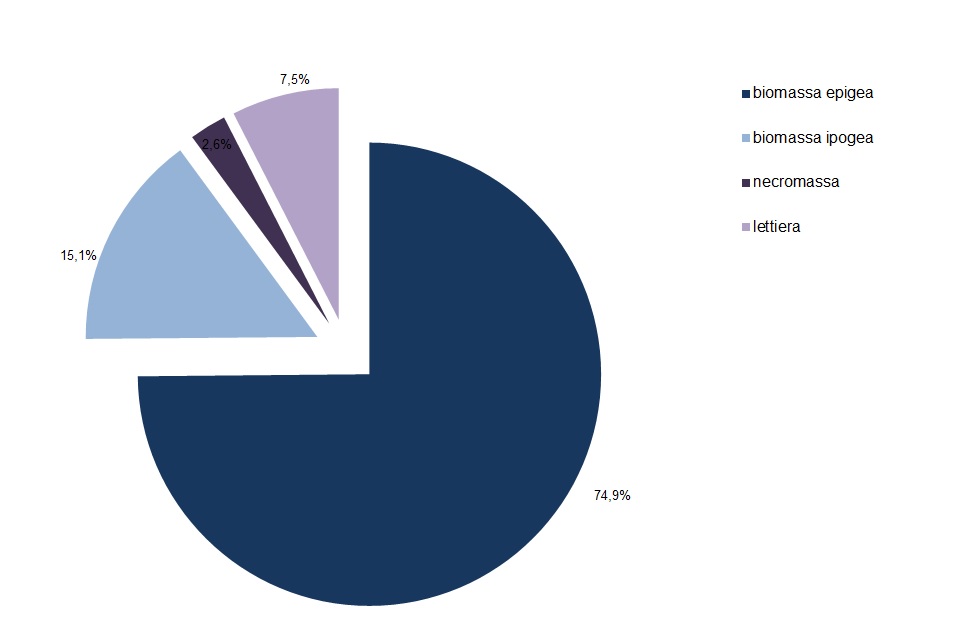
In 2023, the carbon stock stored in Italian forests was estimated at approximately 712.0 million tonnes of carbon (Mt C). Of this total, 533.0 Mt C (74.9%) was stored in above-ground biomass, 107.2 Mt C (15.1%) in below-ground biomass, 18.4 Mt C (2.6%) in dead wood (necromass), and 53.5 Mt C (7.5%) in litter (Figure 1).
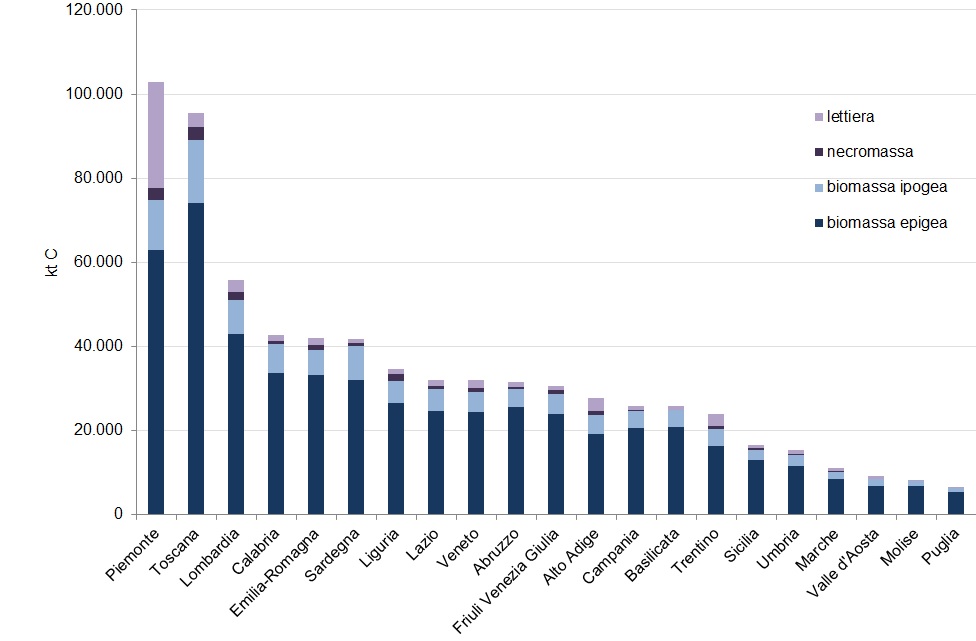
The regional distribution of carbon stock (Figure 2) is strongly correlated with the proportion of land area covered by forests.
Carbon stocks in Italian forests are increasing, marking a net positive greenhouse gas balance (carbon sink),,. This trend is partly the result of conservation policies (characterized by low deforestation rates) and forest protection measures, and partly due to complex economic and social factors that have led to a reduction in timber harvest volumes,. However, in recent years, driven in part by high energy prices, there has been a renewed increase in fuelwood extraction,.
An increase in sequestered carbon is also observed in areas previously used for other purposes and subsequently converted to forest land,. This is due to reforestation (on previously forested land) and afforestation (on previously non-forested land) interventions, occurring through both intentional measures and natural processes, such as natural colonization by forest species on abandoned croplands or other lands,. Of greater concern are carbon emissions related to forest fires, which significantly affect the variation in carbon stock across different forest carbon pools.
| Data |
|---|
Thumbnail
Headline
Figure 1: Carbon stock in Italy, distribution across forest carbon pools (2023) Data source
ISPRA |
Thumbnail
Headline
Figure 2: Carbon stock in different forest carbon pools by regional distribution (2023) Data source
ISPRA |
Thumbnail
Headline
Figure 3: Carbon stock changes (carbon sink) in different forest carbon pools in Italy (1990-2023) Data source
ISPRA |
The carbon sequestered by Italian forest carbon pools has steadily increased, primarily due to the expansion of forested areas resulting from the natural recolonization of marginal lands and abandoned agricultural areas. In 2023, the carbon stock change (carbon sink) in Italian forests amounted to 11.5 Mt C (equivalent to 42.0 Mt of CO₂); this net change accounts for both carbon gains (growth) and losses due to timber harvesting, forest fires, and natural mortality. The carbon sink trend over the 1990–2023 period (Figure 3) is strongly influenced by the extent of forest area affected by wildfires and the consequent reduction in carbon uptake. In fact, the biomass losses from wildfires in 1990, 1993, 2007, and 2017 had a significant impact on the carbon sink trend. This highlights the critical role of forest fires in determining the contribution of national forests to the global carbon cycle.